
Indigenous Peoples Day Student Activities Four Meaningful Ways to Learn and Respect Indigenous Cultures

Indigenous Peoples Day gives students a chance to learn more than a date on the calendar. It invites them to ask better questions about land, language, stories, history, and the living Indigenous communities whose knowledge continues to shape daily life.
The most meaningful classroom activities do not treat Indigenous cultures as something from the past. They help students see Indigenous Peoples as present-day communities with distinct nations, languages, governments, traditions, artists, scientists, writers, and leaders.
The four activities below are designed to be respectful, student-centered, and easy to adapt across grade levels. Each one includes a clear learning focus, a classroom approach, and a reflection prompt that encourages students to think with care.

Start with respect before starting the activity
Before beginning any Indigenous Peoples Day lesson, set a respectful tone. Students should understand that Indigenous Peoples are not one single culture or group. There are many Indigenous nations, each with its own history, language, land relationships, traditions, and contemporary life.
A strong opening can include a few shared agreements:
Use specific nation names whenever possible.
Avoid speaking about Indigenous Peoples only in the past tense.
Treat stories, languages, and cultural practices with respect.
Do not ask Indigenous students to speak for their community.
Check sources and look for materials created by Indigenous authors, educators, artists, or organizations.
This matters because classroom activities can easily become too general. A lesson about “Indigenous culture” should not flatten hundreds of distinct communities into one picture. The goal is to help students practice curiosity, accuracy, and respect.
It also helps to explain that learning about Indigenous Peoples should not happen only on one day. Indigenous Peoples Day can be a meaningful start, but the learning should continue throughout the school year.
1. Use a land and place-based mapping activity
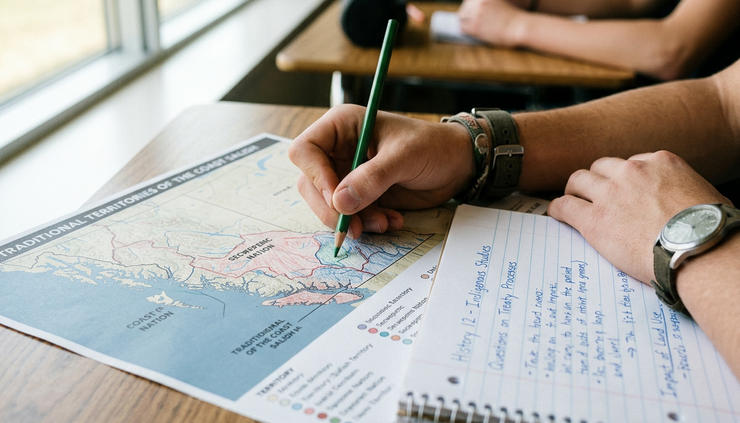
A land and place-based mapping activity helps students connect learning to the place where they live, study, and travel each day. It asks students to look at familiar spaces in a less familiar way.
Many students know their city, town, state, or region by current borders. They may know highways, school districts, neighborhoods, or landmarks. This activity adds another layer by asking students to explore traditional Indigenous territories and consider how place holds history, memory, and responsibility.
A helpful starting tool is Native-Land.ca, an interactive map that shows Indigenous territories, languages, and treaties in many parts of the world. It is a learning resource, not a final authority. Encourage students to treat it as a starting point and compare what they find with information from tribal nation websites, local cultural centers, museums, libraries, or Indigenous-led educational resources.
How to set it up
Begin by projecting a map of the school’s region or asking students to explore in pairs. Students can search for the city, town, or county where they live or where the school is located.
As they explore, ask them to record:
The names of Indigenous nations connected to the area
The languages connected to the area, if listed
Any treaties or related historical information, if available
One question they now have about the place where they live
For younger students, keep the task simple. They can identify one nation name and draw or label a map. Older students can compare sources and discuss why maps can differ depending on who made them, what they include, and what time period they represent.
Reflection prompt
“Whose traditional land do we live on? What did you learn about the Indigenous communities here?”
This question helps students move from “Where am I?” to “Whose histories and homelands are connected to this place?” It also opens a conversation about how land acknowledgments can be more than words. A meaningful land acknowledgment should lead to learning, relationship, and action.
Classroom extension
Students can create a place-based learning journal. Over a week, they can choose one local place, such as a river, mountain, park, neighborhood, or street name, and research its Indigenous history. They might find that a familiar name comes from an Indigenous language or that a local natural feature has long-standing cultural meaning.
The key is to avoid turning the activity into a simple “find and finish” task. Let it become an invitation to keep asking questions.
2. Build understanding through storytelling and narrative reflection
Storytelling is central to many Indigenous cultures, though traditions vary widely across communities. Stories can carry history, humor, values, teachings, family memory, and relationships with land. In the classroom, reading work by an Indigenous author gives students a chance to hear a voice that is specific, creative, and human.
Choose a text written by an Indigenous author rather than a retelling from an outside perspective. The text might be a picture book, poem, short story, essay, memoir excerpt, or novel chapter. What matters most is that the author’s voice leads the learning.
For younger students, picture books by Indigenous authors can open rich conversations. For older students, short fiction, contemporary poetry, speeches, or personal essays can show the range of Indigenous writing today.
How to choose a story
When selecting a text, look for a few signs of strong classroom fit:
The author identifies with a specific Indigenous nation or community.
The story avoids stereotypes and one-dimensional characters.
The text shows Indigenous life as present, complex, and varied.
The material is age-appropriate without oversimplifying the topic.
Any cultural knowledge in the text is shared in a way meant for public learning.
It is also wise to read the text before class and prepare context. Students do not need a long lecture before the story, but they should know the author’s nation or background if the author shares it publicly, the type of text they are reading, and any key terms that may help them understand it.
How to guide the reflection
After reading, give students quiet time to respond before class discussion. This helps them move past quick reactions and into deeper reflection.
Students can respond in several ways:
Write a journal entry.
Sketch a scene or symbol from the story.
Choose one line and explain why it stood out.
Discuss the story in pairs before sharing with the whole class.
Create a “values web” showing ideas such as respect, courage, humor, family, responsibility, or care for land.
Reflection prompt
“What message or value from the story resonated with you?”
This prompt works because it does not ask students to summarize only. It asks them to listen for meaning. A student might notice a value such as generosity, patience, humor, respect for elders, care for relatives, or attention to the natural world.
Make space for different answers. Stories do not always lead to one simple lesson. A respectful discussion allows students to say, “This part made me think,” or “I noticed a connection,” without claiming to fully understand another culture.
3. Explore daily contributions and innovations
Students often learn about inventions and discoveries through a narrow lens. This activity expands that lens by helping them investigate items, foods, systems, and practices developed or shaped by Indigenous Peoples.
The goal is not to create a trivia list. The goal is to show that Indigenous knowledge has long contributed to science, agriculture, foodways, medicine, sports, architecture, environmental stewardship, and everyday life.
Students may be surprised to learn about Indigenous contributions connected to:
Corn, beans, squash, potatoes, tomatoes, cacao, and many other foods
Maple syrup and maple sugar traditions
Snow goggles, kayaks, canoes, and snowshoes
Lacrosse and other traditional games
Hammocks in parts of the Americas
Raised-bed agriculture, irrigation methods, and controlled burning practices in some regions
Plant knowledge used by many communities, with care taken not to treat medicine as a simple recipe
Some examples are broad and connected to many Indigenous communities across large regions. Others belong to specific nations or places. Students should learn to ask, “Which people developed or practiced this?” rather than stopping at “Indigenous Peoples invented this.”

How to run the investigation
Create a list of possible topics or let students choose from a prepared set of cards. Each student or group investigates one item, tradition, or contribution.
Ask students to find:
The item or practice they are researching
The Indigenous nation, region, or community connected to it, when possible
How it was used historically
How it is used or remembered today
One source created by or connected to an Indigenous community, if available
Students can share their findings through a gallery walk. Each group creates a small display with a drawing, a short explanation, and one “I used to think, now I understand” statement.
This format keeps students moving and gives them a chance to learn from one another. It also prevents the activity from becoming a lecture.
Reflection prompt
“What invention or tradition do you use today that originated from Indigenous cultures?”
This question helps students see that Indigenous knowledge is not distant from their lives. A student might think about foods they eat, games they play, outdoor tools they recognize, or words they use.
Encourage students to go beyond “I didn’t know that.” A stronger reflection might sound like this:
“I learned that the foods we call common, like corn and beans, have long histories connected to Indigenous agriculture. I want to know more about the people who developed these food systems and how those traditions continue today.”
That kind of response shows both learning and respect.
A note on cultural care
Some knowledge is not meant for classroom display or casual use. Be careful with sacred practices, ceremonies, regalia, songs, and medicines. If a source says something is private, ceremonial, or community-specific, do not turn it into a student project.
Respect includes knowing when not to copy.
4. Support language revitalization through research and greetings
Language carries more than words. It holds relationships, humor, place names, values, and ways of understanding the world. Many Indigenous languages have faced harm through colonization, boarding schools, forced assimilation, and policies that punished children for speaking their languages.
At the same time, Indigenous communities continue powerful language revitalization work. Families, elders, teachers, apps, immersion schools, community classes, songs, and dictionaries all play a role in keeping languages alive and growing.
A classroom activity on Indigenous languages should center respect. Students can learn about language revitalization without treating languages as novelty phrases to collect.
How to set up the activity
Assign students to research one Indigenous language connected to their region or to a text, nation, or topic already studied in class. If possible, use resources from tribal language programs, nation websites, Indigenous educators, or public language projects.
Students can look for:
The name of the language
The nation or community connected to it
Where the language is spoken
Whether there are public learning resources
A greeting or word that the community has shared for public use
Efforts underway to teach or revitalize the language
If students learn a greeting, teach them to say where it comes from. A greeting should not be treated as a random phrase. It belongs to a language and a people.
For example, a student might say, “This greeting comes from the Cherokee language,” if they are using a public Cherokee language resource. Another student might learn about Hawaiian, Diné Bizaad, Ojibwe, Lakota, or another language through sources made for learners.
Reflection prompt
“What can we learn from the languages of Indigenous Peoples?”
Students may notice that languages reflect relationships to land, family, community, and responsibility. They may also learn that language loss is not natural or accidental. It often connects to specific histories of government policy and cultural suppression.
A thoughtful response might include both respect and hope:
“I learned that language revitalization is about identity and community. When people teach a language to children again, they are also passing on memory and connection.”

Tips for making these activities meaningful
The best Indigenous Peoples Day student activities are not complicated. They are careful. A simple lesson can be powerful when it uses good sources, avoids stereotypes, and asks students to reflect honestly.
Keep these teaching moves in mind as you plan:
Choose Indigenous-created sources when possible. Books, videos, websites, and classroom resources made by Indigenous people bring stronger voice and context.
Name specific nations and communities. Avoid using “Indigenous” as if it describes one culture.
Connect past and present. Students should learn history while also seeing contemporary Indigenous life.
Avoid crafts that copy sacred items. Projects that imitate regalia, ceremonial objects, or spiritual symbols can cause harm.
Invite local learning. If appropriate, learn from public resources shared by local tribal nations, cultural centers, or educators.
Let reflection matter. Students need time to process what they learned and how their thinking changed.
A useful closing activity is a class commitment chart. Ask students to finish one of these sentences:
“One thing I learned about this place is…”
“One question I still have is…”
“One way I can show respect is…”
“One source I want to learn from next is…”
This turns the lesson from a one-day activity into an ongoing practice of learning.
A thoughtful way to close the day
Indigenous Peoples Day should leave students with more than facts. It should help them build habits of respect: listening carefully, naming people accurately, questioning simple stories, and recognizing the living presence of Indigenous communities.
The four activities in this guide, mapping land, reading Indigenous stories, exploring daily contributions, and learning about language revitalization, all point toward the same lesson. Understanding grows when students connect knowledge with responsibility.
A strong final reflection can be simple:
“What is one thing you understand differently now, and what will you keep learning?”
That question gives students room to grow. It also honors the purpose of the day: not to finish learning about Indigenous Peoples, but to begin learning with more care.


Comments